
The Dreamscape
A midground between imagination and perception.
Is it possible to create a haven where designers are bodily present in their early spatial ideas as they conceive them?
Can virtual reality, a frontier that merges the digital and physical worlds, offer a medium in which people can fully immerse themselves in their own creations?
Step into the Dreamscape experience to uncover the answers.
Discover
Dreamscape Bricks VR
Dreamscape Bricks VR is an experimental VR design tool that uses LEGO® bricks as building blocks for creating designs in a virtual design environment, to support early-stage spatial experimentation. The application invites users to explore a VR environment where they can be bodily present within developing spatial ideas, using an immersive virtual design environment powered by Unreal Engine.
Dreamscape Bricks VR is based on the DREAMSCAPE framework, allowing users to construct and explore their creations using LEGO-like blocks, focusing on the embodiment, experience, and manipulation aspects of the design process. With intuitive controls and direct object manipulation interactions, Dreamscape Bricks VR moves away from several conventions of desktop CAD interaction, and tests how component-based spatial modelling works in an embodied VR setting.
THE FRAMEWORK

Introducing the
DREAMSCAPE Framework
The DREAMSCAPE framework, which stands for Digital Reality Environment as A Medium for Studio Collaboration in Architectural Production and Education, proposes a framework for VR-based design tools by focusing on the unique potentials and limitations of VR, moving away from conventional CAD vocabulary. The framework's approach examines how VR interaction can draw on embodied actions rather than relying only on inherited CAD commands.
Many existing VR design tools rely on legacy CAD-inspired methods, restricting designers' engagement with their work in virtual space. Traditional CAD interfaces and interactions, such as menus, buttons, point-and-click interfaces, and object manipulation commands, were developed primarily for 2D displays and keyboard and mouse input. These inherited interactions are not well suited for VR and can unnecessarily restrict designers' engagement with their work in a virtual space.
The DREAMSCAPE framework counters these limitations with Dreamscape Bricks VR, which uses modular building components (virtual LEGO pieces) for future studies comparing design processes in physical and VR environments, supporting embodied design interaction.

To achieve this, the DREAMSCAPE framework proposes a design process based on three activity types that occur iteratively in spatial and temporal succession:
EMBODIMENT
Conceptualize spatial design ideas within the virtual environment
EXPERIENCE
Occupy and inspect the preliminary design output
MANIPULATION
Modify the design output and continue the design iteration
Central to the DREAMSCAPE framework is the concept of direct manipulation, allowing users to interact with virtual objects using intuitive visual and physical actions.
By applying the DREAMSCAPE framework, architects and designers can use VR as an active medium for spatial design rather than a passive tool for visualisation, with attention to embodiment, spatial experience, and direct manipulation.
Features
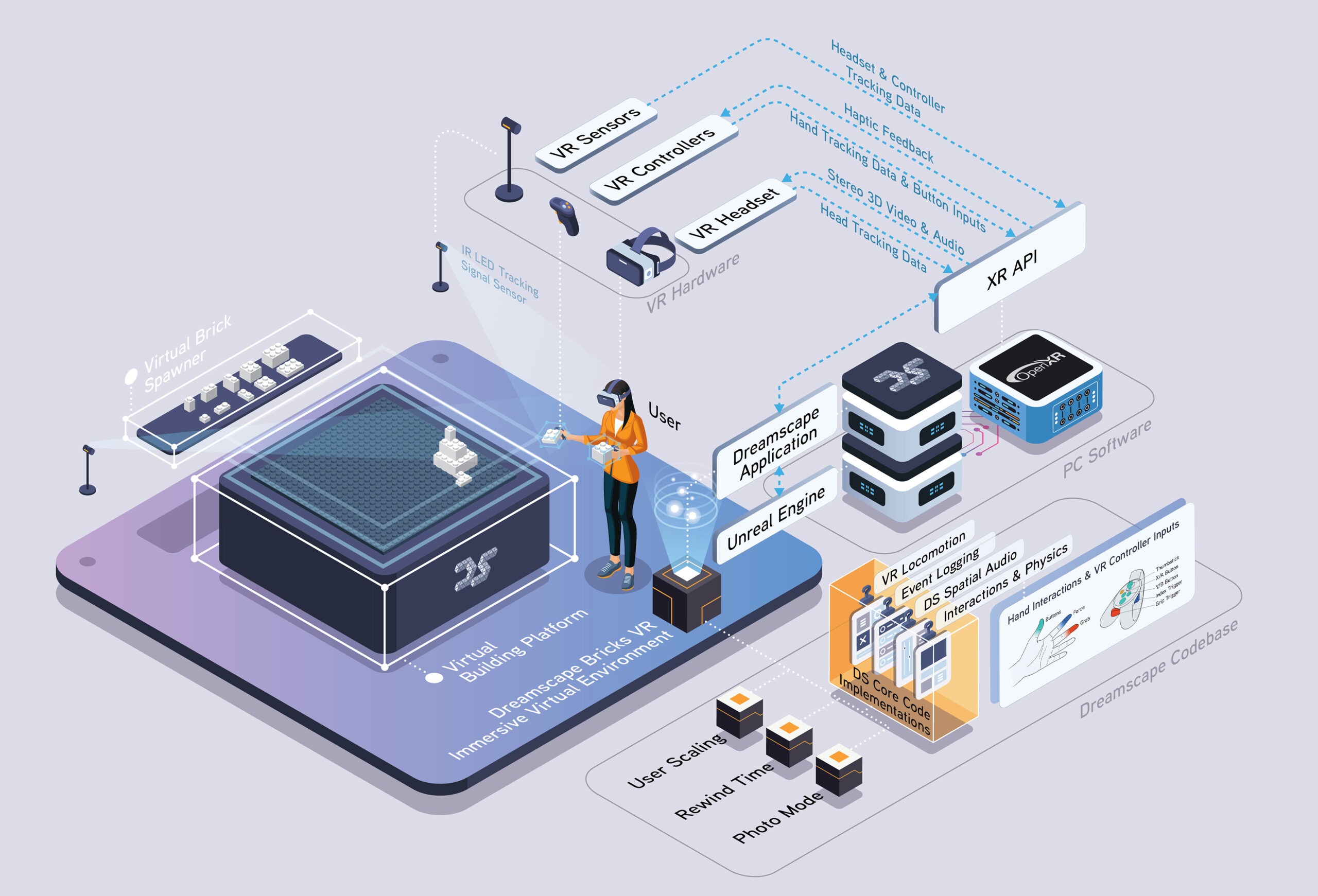
Dreamscape Bricks VR is an experimental design tool that provides an immersive and intuitive design experience in VR, allowing users to construct and adapt architectural designs using virtual LEGO bricks, complete with a host of features including user scaling, temporal rewind, and interaction logging.

Intuitive Interactions
Use finger and grip gestures mapped to brick selection, placement, and manipulation with the VR controllers, supporting interaction with virtual construction bricks while working with virtual LEGO bricks.
Scaling the User
Freely switch between three predefined scales – lifesize bricks (1:1), precision building scale (1:10), and figure-sized user (1:42.5) – to compare work at object, model, and inhabitable scales during the design process.
Temporal Rewind
Step backwards through recorded design actions, backtrack through your design steps to correct mistakes and explore alternative design paths without starting over.
Other Features
Additional features include locomotion in VR, save/load system, tutorials, audio, haptics, photo mode, design stats, and event logging, supporting prototype use, observation, and data collection.

The DREAMSCAPE research
DREAMSCAPE is an academic research project by Oğuz Orkun Doma and Prof. Dr. Sinan Mert Şener from Istanbul Technical University. The project investigates the process of architectural design experienced by designers across physical and virtual design environments, as part of Doma's PhD research. Check out the academic publications below which describe the framework, prototype, study design, findings, and insights.

DREAMSCAPE: Use of Virtual Reality in Architectural Design & Education
Oğuz Orkun DOMA. 2023.
Advisor: Prof. Dr. Sinan Mert Şener
Ph.D. thesis. Architectural Design Computing program, Istanbul Technical University. https://dx.doi.org/10.13140/RG.2.2.35256.11526/2
Dreamscape Bricks VR: An Experimental Virtual Reality Tool for Architectural Design
Oğuz Orkun DOMA, Sinan Mert ŞENER. 2022. Interaction Design and Architecture(s), 52, 234–258. https://doi.org/10.55612/s-5002-052-013
An investigation of architectural design process in physical medium and VR
A/Z : ITU Journal of Faculty of Architecture, 19(3), 145–163. https://doi.org/10.5505/itujfa.2022.77019
Using Modular Construction Brick-Based CAD in Online Design Education
CIVAE 2021 - 3rd Interdisciplinary and Virtual Conference on Arts in Education, July 14-15, 2021, Madrid, Spain (pp. 106–111)

Highlights from Sónar+D İstanbul 2023!
Dreamscape Bricks VR was showcased at Sónar+D İstanbul 2023 on Saturday, April 29th between 12:00 PM and 5:30 PM.
Throughout the event, participants immersed themselves in the world of Dreamscape Bricks VR, had the opportunity to explore and create using LEGO® bricks as building blocks, engaging with the tool’s brick-based creativity in the virtual design environment, and learned more about the innovative design approach and technology behind the application.
The DREAMSCAPE project is an academic research by Oğuz Orkun Doma and Prof. Dr. Sinan Mert Şener from Istanbul Technical University. The project investigates the process of architectural design experienced by designers in physical medium and in virtual reality, as part of Doma's PhD research. LEGO, LEGO Architecture, the LEGO logo, and the Minifigure are trademarks and copyrights of the LEGO Group, which does not sponsor, endorse, or authorize the non-profit and academic DREAMSCAPE project. The brick inventory, reproduced as 3D models for the Dreamscape Bricks VR application, follows the LEGO Group's "fair play" guidelines and uses the LDraw library as a reference.